
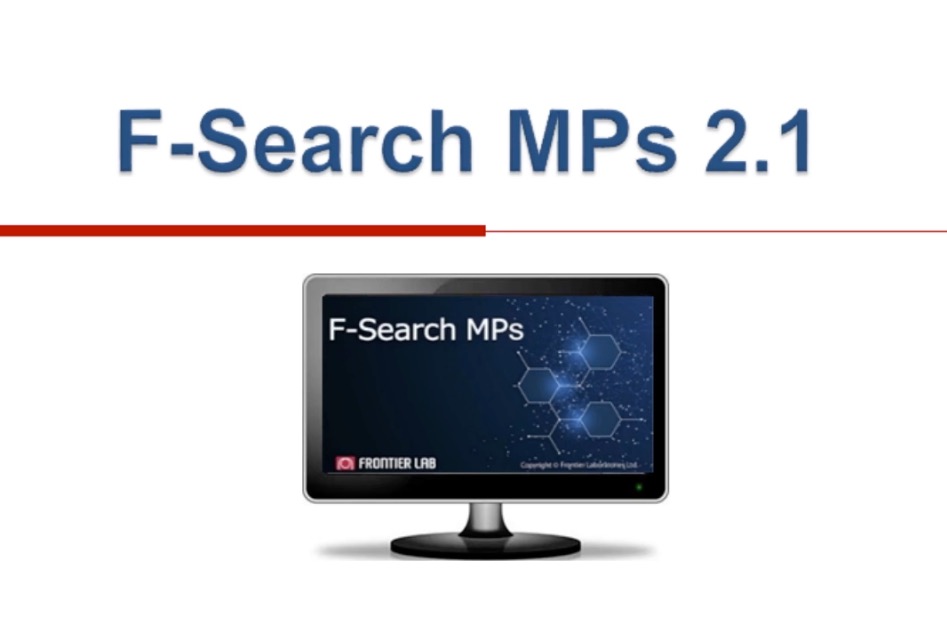
Want to learn more about a powerful analytical software solution for microplastics analysis? Below we break down everything you need to know about F-Search MPs 2.1 software.
F-Search MPs 2.1 allows users to easily identify and quantify unknown microplastics in the environment. It consists of a sophisticated search program with mass spectral libraries of pyrolyzates. The software is used with the data obtained by pyrolysis-gas chromatography/mass spectrometry. The analytical procedures are very easy and straightforward.
One of the benefits of F-Search MPs 2.1 is that it enables identification of polymers accurately based on pyrolyzates information. The powerful software also enables the creation of calibration curves for the registered polymers (ISTD or ESTD) automatically based on the analytical results from the reference polymer mixture. Then, F-Search MPs 2.1 automatically performs quantification with the results instantly reported for the environmental microplastics.
F-Search MPs 2.1 has a library that includes 12 of the most commonly used polymers.
These include:
Yes! Users can create their own library of polymers and integrate it with F-Search MPs 2.1.
There are four basic steps when using F-Search MPs 2.1 to identify unknown microplastics.
Step 1 – Adjustment of retention index (RI)
Step 2 – Create a calibration file (QFL)
Step 3 – Qualitative/quantitative analysis of actual microplastics analysis data
Step 4 – Interpretation/review of results
Video – Microplastics Analysis Using Pyrolysis-GC/MS
This short explainer video, we describe the importance of microplastics analysis and how scientists use vertical-furnace pyrolysis-GC/MS to identify and quantify unknown microplastic polymers.
eBook – Microplastics Analysis Using Micro-Furnace Pyrolyzer and F-Search MPs
eBook features a compendium of application and technical notes demonstrating microplastics analysis using micro-furnace pyrolyzers.
On-Demand Webinar – Quantification & Identification of Microplastics in Air Using Pyrolysis-GC/MS
Microplastics in air samples are identified and quantified using the powerful Pyrolysis-GC/MS technique, featuring a multi-mode, micro-furnace pyrolyzer and a powerful microplastic software engine.
Article – 5 Reasons Labs Use Pyrolysis for Microplastics Analysis
Microplastics has become a hot environmental topic and critical research area for many plastics manufacturers and product consumers.